English learners often stumble over deceptively simple verbs like set or sit. At first glance, they look almost interchangeable. After all, both deal with positioning and placing. But here’s the catch—while these two words sound similar and sometimes appear in overlapping contexts, they follow very different grammar rules.
You’ve probably heard someone say, “I’ll set here” when they really mean “I’ll sit here.” Or maybe you’ve written “He sat the book down” when the correct choice was “He set the book down.” These small errors may feel minor, but they can stand out in academic essays, professional emails, or job interviews.
The difference between set and sit comes down to two key things: whether the verb is transitive or intransitive, and whether the action involves an object. Once you understand this distinction, choosing the right word becomes second nature.
This guide will walk you through definitions, grammar rules, conjugations, real-world examples, idiomatic uses, and even memory tricks to help you never mix up set and sit again. By the end, you’ll know exactly when to use each—and you’ll feel more confident in your writing and speech.
Understanding the Basics
What Does “Sit” Mean?
The verb sit means to rest in a seated position or to be in a state of resting on a surface. The important point: sit is always intransitive, which means it doesn’t take a direct object.
- ✅ Correct: I sit on the couch every evening.
- ❌ Incorrect: I sit the book on the couch.
In everyday usage, sit is typically used with people and animals, but it can also describe things in a figurative sense:
- The house sits at the corner of the street.
- A coffee mug sat on the table all morning.
What Does “Set” Mean?
The verb set means to put or place something in a specific location or position. Unlike sit, set is always transitive, which means it requires a direct object.
- ✅ Correct: She set her phone on the desk.
- ❌ Incorrect: She set on the desk.
Notice the pattern: if you’re doing something to an object, you’ll likely need set. If you’re describing your own position or someone else’s, you’ll use sit.
Key Grammar Differences Between Set and Sit
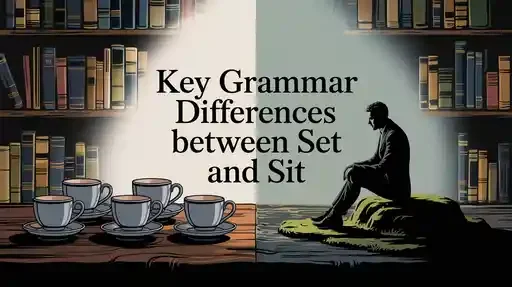
The easiest way to remember the difference is to think about who or what is being moved:
- Sit → The subject positions themselves. No object needed.
- Set → The subject places something. An object is always involved.
Here’s a quick grammar snapshot:
| Verb | Transitivity | Definition | Example |
| Sit | Intransitive (no object) | To rest or be seated | She sat on the bench. |
| Set | Transitive (requires object) | To place or put something | He set the glass on the counter. |
To visualize:
- You sit yourself down.
- You set the object down.
Conjugation and Forms
English irregular verbs add another layer of confusion. Let’s look at the forms.
Conjugation of “Sit”
| Tense | Form | Example |
| Present | sit / sits | I sit here every morning. |
| Past | sat | She sat quietly in class. |
| Past Participle | sat | They had sat there for hours. |
| Present Participle | sitting | He is sitting on the sofa. |
Conjugation of “Set”
| Tense | Form | Example |
| Present | set / sets | I set the table before dinner. |
| Past | set | She set the alarm at 10 p.m. |
| Past Participle | set | They had set the stage perfectly. |
| Present Participle | setting | He is setting his phone aside. |
Note: Unlike “sit,” the word set doesn’t change in its past forms. Present, past, and past participle all look the same. This is a common trap for learners.
Examples in Context
Everyday Situations with “Sit”
- Please sit down before the movie starts.
- She sat at her desk waiting for the email.
- The cat sits on the windowsill every morning.
Idiomatic and figurative uses:
- Sit tight until I call you.
- That decision doesn’t sit well with me.
- He decided to sit out the last round of the game.
Everyday Situations with “Set”
- She set her coffee mug on the counter.
- He set the chairs in a row for the meeting.
- They set the pace for the entire race.
Idiomatic and figurative uses:
- Let’s set the stage for tomorrow’s presentation.
- The sun sets in the west.
- They set their differences aside and worked together.
Common Mistakes and How to Avoid Them

Mixing up set and sit usually happens when people don’t think about whether the action involves an object.
- ❌ I’ll set here while you go inside.
✅ I’ll sit here while you go inside. - ❌ He sat the groceries on the counter.
✅ He set the groceries on the counter. - ❌ She sat the baby in the crib.
✅ She set the baby in the crib.
Checklist to avoid errors:
- Is the action happening to yourself? → Use sit.
- Is the action happening to an object? → Use set.
Idioms, Phrasal Verbs, and Expressions
With “Sit”
- Sit tight → wait patiently.
- Sit back → relax, often while someone else does the work.
- Sit out → choose not to participate.
- Sit well with → be acceptable.
With “Set”
- Set up → establish or arrange.
- Set off → cause something to start.
- Set aside → reserve or save.
- Set in motion → initiate an action.
These idioms extend beyond literal meanings, so knowing them boosts both fluency and comprehension.
Memory Tricks to Remember the Difference
Here are some easy mnemonics:
- Sit = Self. If you’re moving yourself, it’s sit.
- Set = Something. If you’re moving something else, it’s set.
Visual analogy:
- Imagine yourself on a chair → you sit.
- Imagine placing a book on the chair → you set it down.
Practice Exercise:
Fill in the blank with set or sit:
- Please ___ the vase on the shelf.
- I usually ___ in the back row.
- He ___ his alarm for 6:00 a.m.
- They ___ at the cafe all afternoon.
Practical Applications
Formal Writing
Using the wrong verb in essays or professional emails undermines credibility. Example:
- Incorrect: I will set in the meeting at 3 p.m.
- Correct: I will sit in the meeting at 3 p.m.
Everyday Conversation
Misusing these verbs is one of the quickest ways to sound less fluent. People often notice mistakes like “I’ll set over there” instantly.
For ESL/EFL Learners
Teachers and examiners specifically look for these kinds of errors in IELTS, TOEFL, and Cambridge exams. Mastering set and sit gives you a stronger edge.
Quick Reference Guide
Here’s a simple summary you can keep handy:
| Rule | Use “Sit” | Use “Set” |
| Object needed? | ❌ No | ✅ Yes |
| Who/what moves? | The subject itself | The subject moves an object |
| Conjugation | sit, sat, sat, sitting | set, set, set, setting |
| Example | She sat by the window. | She set her bag by the window. |
Conclusion
The debate between set or sit isn’t really a debate once you understand the rules. Sit never takes an object; it’s about where you place yourself. Set always needs an object; it’s about putting something else in a position.
By practicing with examples, remembering the self vs. something trick, and paying attention to context, you can eliminate one of the most common English grammar errors.
Small distinctions like this matter. They don’t just polish your grammar—they boost your confidence, sharpen your communication, and help you sound natural in both writing and speech. So next time you pause and wonder whether to use set or sit, you’ll know exactly which verb belongs.

Emma Rose is an experienced English educator, writer, and language enthusiast dedicated to helping learners unlock the full power of the English language. At SynoEnglish, she shares practical grammar tips, clear explanations, and real-world language insights to make learning both effective and enjoyable. With a passion for words and a love for clarity, Emma’s goal is to help readers speak and write with confidence.


